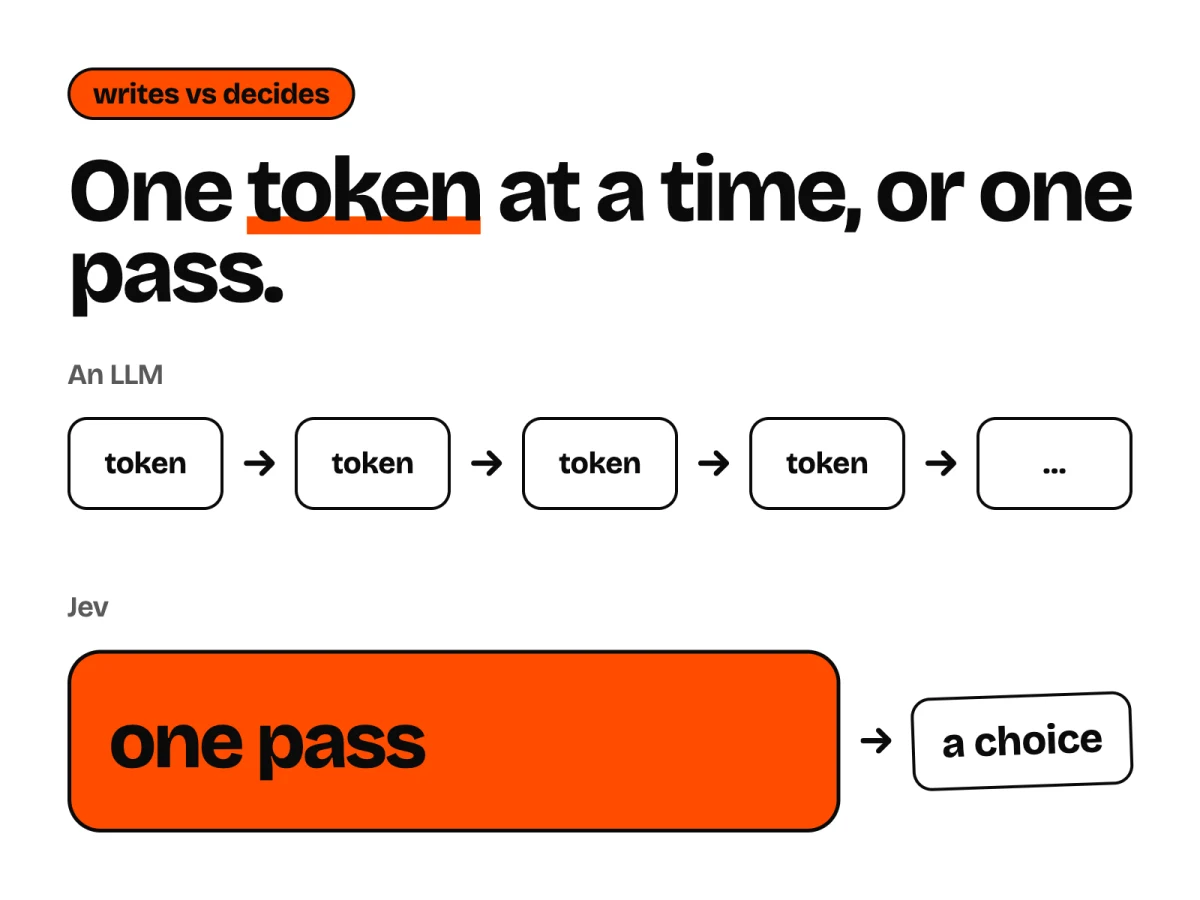
Jev, an AI Model, never writes a single sentence. Instead, Jev is a different class of AI Model that picks the best choice based on a set of options provided, hence known as a classification model. Unlike a LLM (Large Language Model), Jev does not write a single token, and hence returns responses in milliseconds for an extremely low cost.
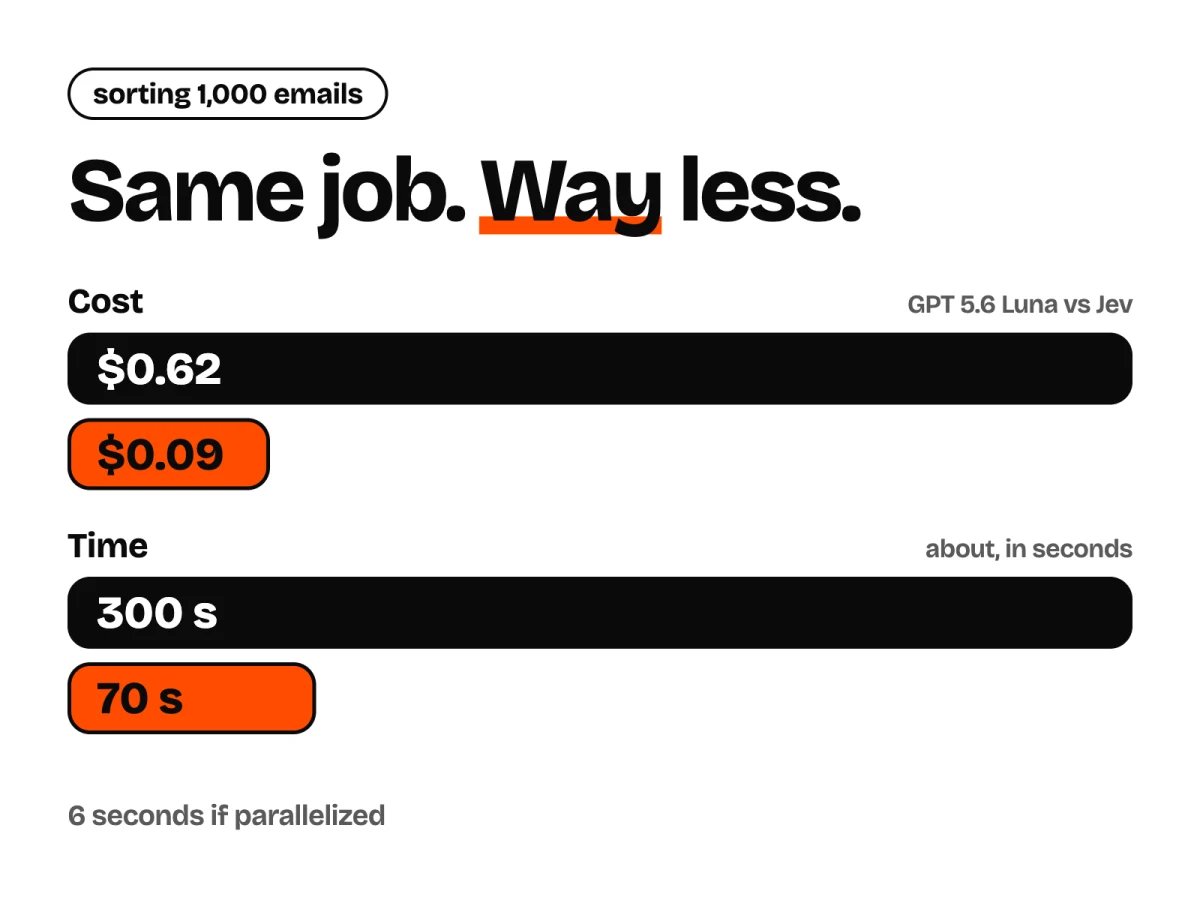
Many people and businesses rely on AI to make decisions, be it a tool call for a coding agent, an email sorter, or even categorizing complaints and bugs. Generally, LLMs are used to make these decisions by generating a whole paragraph, and thinking token by token only to return an answer by a yes or a no. This wastes precious time and money since a huge amount of resources (tokens) are being used only to provide a small answer. It is almost like renting an essay engine to answer a multiple choice question. As an example, GPT 5.6 Luna can sort 1,000 emails for $0.62 taking about 300 seconds, versus Jev using $0.09 in about 70 seconds (6 seconds if parallelized). Since many companies leverage over cost and time improvements through optimisations in AI Technology. This makes the launch of classification models all the more important.
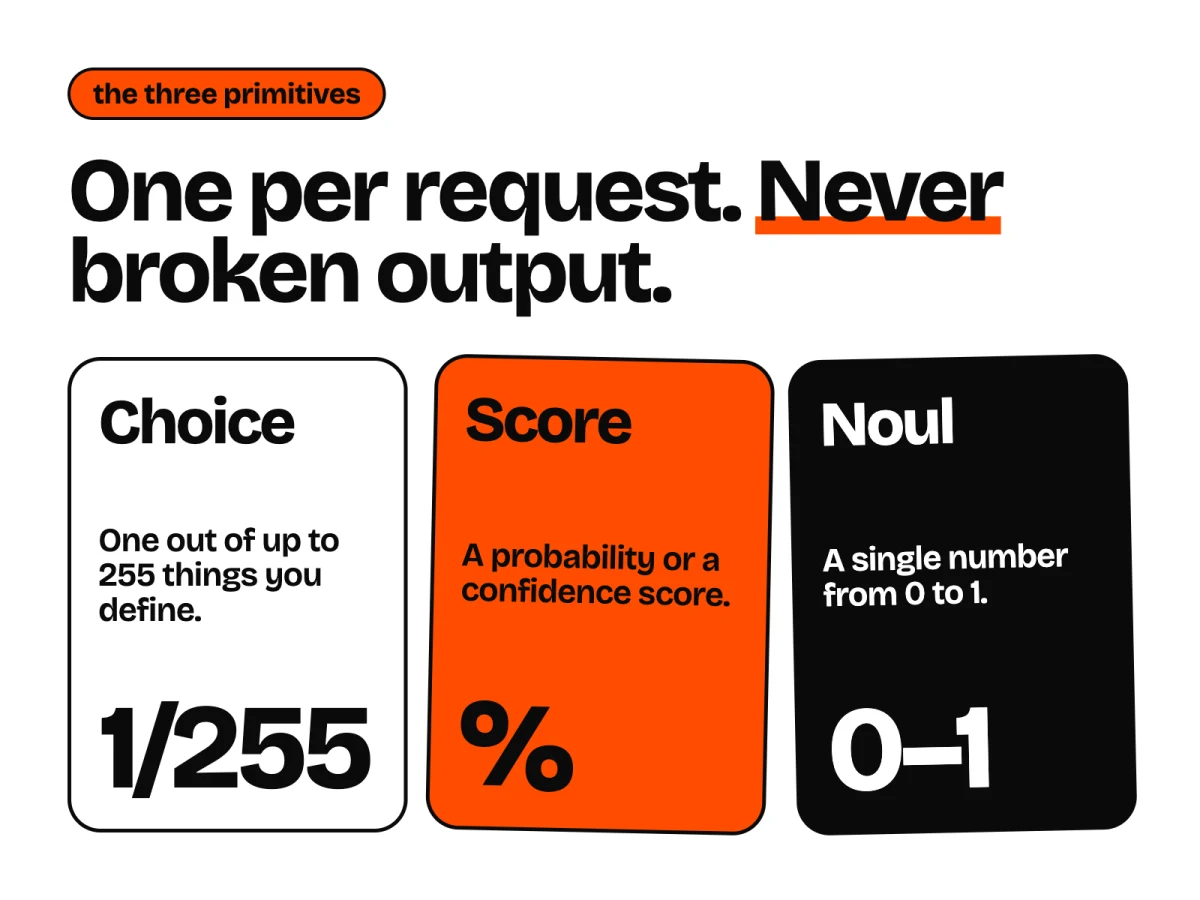
TypeSafe AI, the creators of Jev, unveiled this model on September 15, 2026 calling it a System One Model (named after Jevons) with a fast instinct instead of a prolonged deliberation to work well with systems that are optimised for time. More specifically, you can provide Jev with choices (pick one out of up to 255 things that you define) for it to return one of the selections, or a score (probability or confidence score), or even a noul (a single number from 0 to 1). With each request, only one of the three primitives can be addressed. This ensures that Jev’s output will always be in a constant format, and it can never return an answer with broken formatting or malformed output. If a support email needs to be sorted in one of five categories, in about 70 milliseconds, Jev will come back with the choice in an appropriate format.
Compared to Jev, a normal LLM is known to be autoregressive, meaning that it writes one token, then calculates the probability of the next best token based on the current, and then writes the next one. So, a JSON response by a LLM would probably be hundreds of sequential forward passes, with a high room for error in output syntax but also in time used. Jev produces its outputs in one query done in parallel. This means that Jev returns the output in one pass, using a system called Reinforcement Learning for Calibrated Decisions (RLCD), which is optimised for honest probabilities. In addition to this, every choice and a score carries a confidence value which Jev derives from the probability distribution. TypeSafe AI claims that this probability is calibrated, meaning that a higher confidence level does meaningfully represent a high accuracy statistically. In practice the accuracy rating is more valuable than it sounds. This is because if a LLM can get a task right 90% of the time but it cannot firmly state which 10% of the tasks it got wrong, these tasks cannot be automated and are not suited for industrial use.
This trustworthy system only matters if it’s cheap enough to run everywhere. TypeSafe released in its benchmarks that Jev is 194x faster and 445x cheaper than two other LLMs. Furthermore, it’s reported that an average response time is 70 to 500 ms, against 3 to 329 seconds for the same type of general tasks. The pricing for Jev is $0.042 per million input token and free output tokens because it never generates any. However, one limitation is Jev’s reasoning. In TypeSafe’s own benchmark, it has about a 68% accuracy on the four-workflow benchmark which proves that Jev has a real ceiling, and should only be prioritized for tasks that need fast and cheap critical thinking, not deep reasoning.
With the incredible capability with extremely low cost, providing Jev with relevant use cases is now at paramount importance. Jev should be reached when you make a small decision thousands of times in a day to optimize your workflow. Developers are using Jev as the decision maker to give better tool routing for their AI agents. Companies are leveraging Jev to better handle customer support emails. Professionals use Jev to quickly sort out their emails in real time to better manage their work. Someone even used Jev to play Doom for them (making 10 decisions in a second) for only $7 in an hour. The above examples certainly prove that the use cases of this system one model is more than what meets the eye. With this being said, Jev is not just a better LLM, it’s a totally different type of model. Jev is the first of its kind that separates things that write from things that decide.
Sources:
- https://www.linkedin.com/posts/nateherkelman_i-tested-jev-on-12-real-use-cases-my-honest-ugcPost-7507127830930046976-6pTR/
- TypeSafe AI, “Introducing System One Models & Jev”, 15 September 2026: typesafe.ai/blog/introducing-system-one-models-and-jev
- TypeSafe AI documentation, introduction, primitives and confidence pages: docs.typesafe.ai
- Towards Data Science, “Jev vs. LLMs: When AI Moves from Generation to Decision-Making”, 25 September 2026
- MarkTechPost, “TypeSafe AI Releases Jev”, 19 September 2026
- TrueFoundry, “TypeSafe AI’s Jev: What System One Models Actually Are”, 18 September 2026
- Failproof AI, “Jev vs LLM: typed decisions compared with generated text”: befailproof.ai/jev/vs-llm
- LangChain, “What Is Jev? A Guide to TypeSafe AI’s System One Model”, 18 September 2026